
Your Customers Aren't Abandoning Their Cart — They're Thinking
By jason thompson | 33 Sticks
Every ecommerce dashboard has a cart abandonment rate. It typically sits somewhere between 60-80%, everyone agrees it's too high, and nobody agrees on what to do about it. And the playbook seems to be always the same: exit-intent pop-up, abandoned cart email at 30 minutes, retargeting ads with the product image, maybe a discount code if they haven't come back in 24 hours.
The assumption behind all of it is that something went wrong. The price was too high, the shipping was confusing, the checkout had too many steps. The customer left, and our job is to drag them back.
But i've been doing this work long enough to know that aggregate metrics lie. And cart abandonment rate is one of the worst offenders.
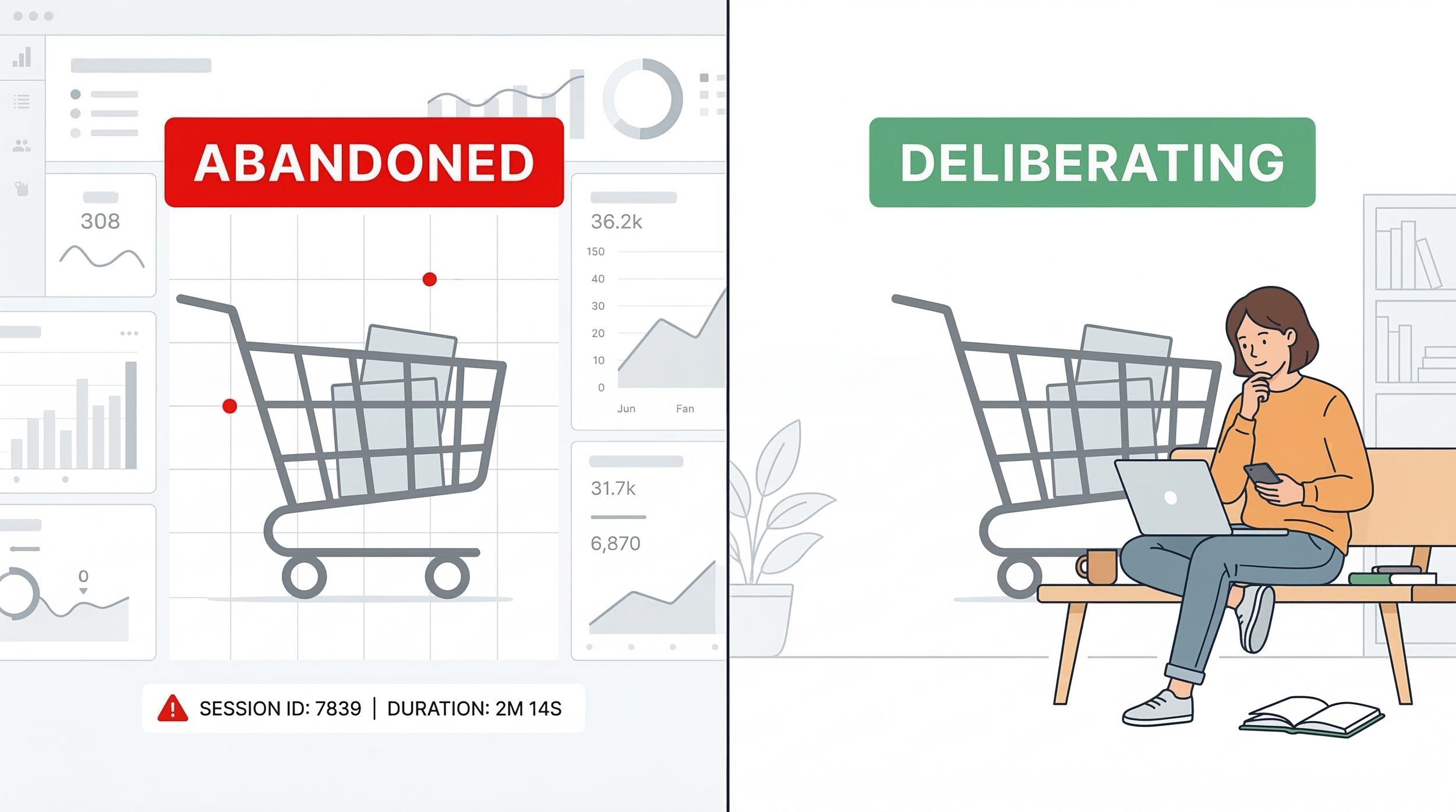
One number hiding three behaviors.
That 70% abandonment rate is technically accurate and almost entirely useless, because it's hiding at least three distinct groups:
People who were never going to buy: They fat-fingered add to cart on mobile, they were browsing with no intent, they're gone
People who are using the cart as a wishlist: They'll come back in a week, a month, maybe never
People who are actively deliberating: They intend to buy, but not right now
These three groups require completely different responses. But most analytics implementations can't tell them apart, so the remarketing engine treats them identically. A laptop researcher gets the same "you forgot something!" email as someone who accidentally tapped a button on their phone.
The segments aren't hard to build
Here's what's frustrating, the technique to separate these groups has existed for years. Sequential segmentation with time constraints. It's in Adobe Analytics. It's in GA4's audience builder. It's not exotic.
Visit A: cart addition, no purchase. They left without buying.
THEN within [time window].
Visit B: purchase. They came back and bought.
Build four of these. 4 hours, 12 hours, 24 hours, 48 hours. Each is cumulative, so you subtract to get the exclusive time buckets. Twenty minutes of work, maybe.
i rarely see teams actually do this. They look at the aggregate abandonment rate, send the same retargeting sequence to everyone, and move on. The segmentation capability is sitting right there in the tool. Few actually use it.
What you'll probably find
i can't tell you exactly what your data will show, but i can tell you what we consistently see when we run this analysis across ecommerce clients:
The deferred purchase segment is bigger than anyone expects.Teams assume it's a rounding error, 2-3% of orders, maybe. It's usually somewhere between 10-20%. Now, that's a segment worth designing for.
They spend more.Deferred purchasers tend to have meaningfully higher AOV than the baseline. This makes sense once you see it, nobody needs to sleep on a $20 purchase. The deliberation behavior self-selects for higher-consideration, higher-value products.
The product mix shifts across time windows. This is the one that changes the conversation. The 0-4 hour returners look a lot like your general customer base, just slightly elevated. But as the return window stretches — 12 hours, 24 hours — the product mix starts skewing hard toward big-ticket, high-consideration categories. Appliances. Electronics. Furniture. The stuff people need to measure, research, discuss with a partner, or compare prices on.
Impulse categories drop out. Nobody deliberates over a phone case.
They buy more items. The return visit tends to produce a bigger basket, not just recovery of the original item. Something about coming back with intent, having already made the mental commitment, opens people up to adding more.
The retargeting implications
Once you see these segments, the standard abandoned cart playbook starts looking pretty blunt.
Your timing matters more than your creative.If a big chunk of deferred purchasers come back within 4 hours, and your retargeting doesn't fire for 24, you've missed the peak window entirely. And the person who comes back at 2 hours is in a different headspace than the person who comes back at 18 hours. One needs a nudge, the other needs reassurance.
"You forgot something" is the wrong message for someone who didn't forget. A person deliberating on a major appliance knows exactly what's in their cart. They don't need a reminder. They need the thing that closes their open question like a review summary, a delivery timeline, a price-match guarantee, a comparison chart. Match the message to the deliberation, not the abandonment.
The return visit is an upsell moment. If deferred purchasers are already coming back with bigger baskets, there's something about the second visit that expands the order. Are you surfacing accessories, bundles, or complementary products for someone returning to a saved cart? Most sites aren't, because they're too focused on recovering the original item to notice the expansion happening.
Stop designing against the exit. Exit-intent pop-ups, countdown timers, "only 3 left!" urgency messaging, these all assume that leaving is the failure state. For high-consideration purchases, leaving is the buying process. The better investment is making the return frictionless by including persistent carts, saved-for-you emails timed to the right window, comparison tools that help them finish the research they left to do.
This isn't really about cart abandonment
i'm writing about carts because it's a concrete example, but the real point is broader. This pattern, an aggregate metric hiding fundamentally different behaviors, shows up everywhere in analytics.
Bounce rate hides engaged scanners and misclicked ad traffic. Time on site hides confused users and deeply engaged readers. Conversion rate hides one-session buyers and multi-visit researchers.
The analysts who consistently surface actionable insights are the ones who look at a settled, accepted metric and ask questions like, what if this number is actually three different things? Then they build the segments to find out.
It usually takes less than 30 minutes to setup the analysis. The strategy shift that comes out of it is usually worth a lot more than that.
jason thompson is the CEO of 33 Sticks, an analytics consulting bontique that helps companies stop staring at dashboards and start understanding what their customers are actually doing. If this kind of analysis is the stuff you wish your team had time for, let's talk.