
We tore apart two hotel booking experiences. Here's what we actually look at.
When our clients ask how they compare to competitors, we don't just browse the website. We inspect what they're measuring, how they're measuring it, and what that reveals about their priorities. Here's a sneak peek how we do it.
We picked two of the largest hotel companies on earth. Marriott and Hilton. Same search. Nashville, Tennessee. Two nights. One adult. April 2026.
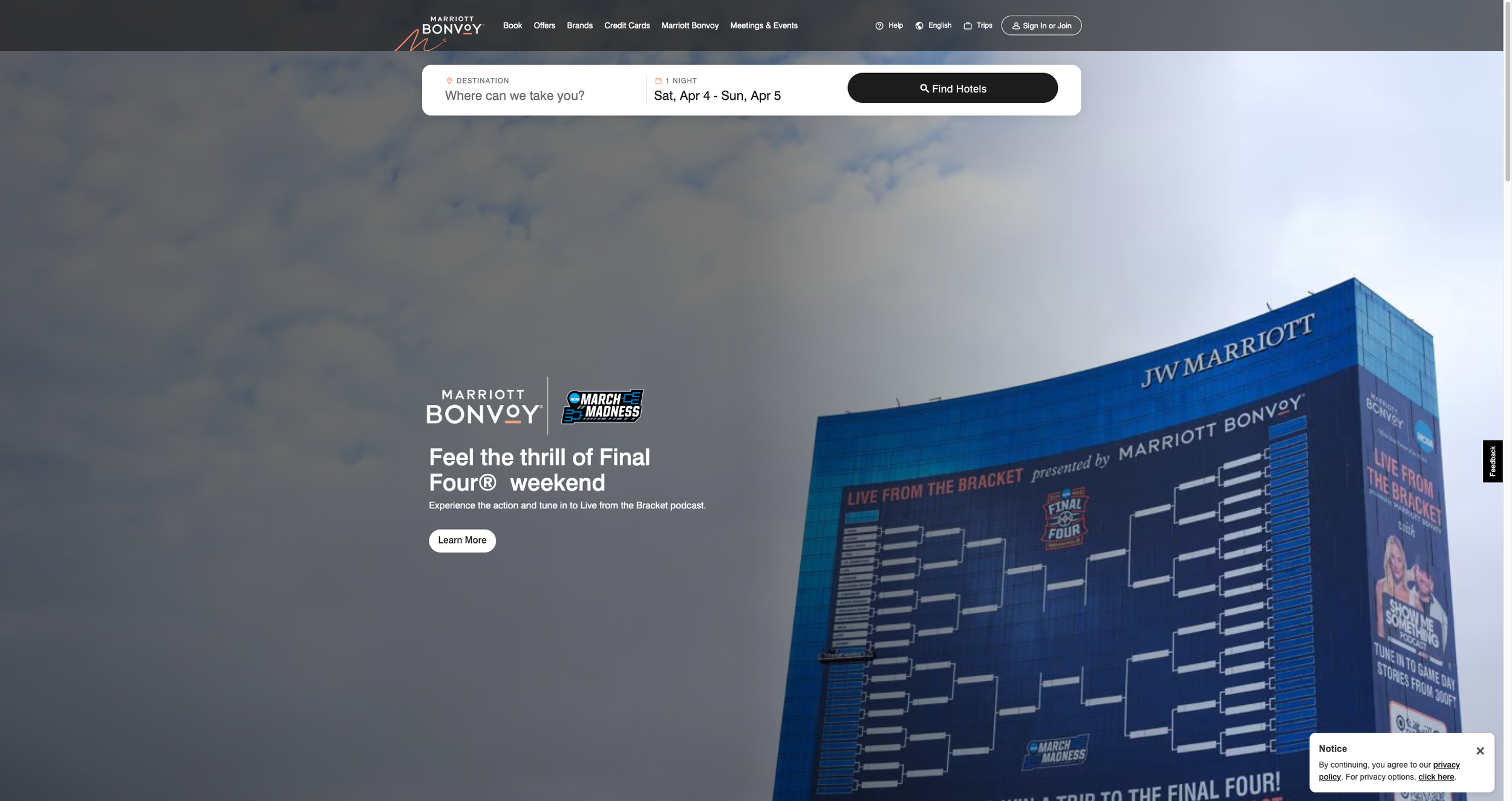
Marriott.com: Clean search bar, March Madness partnership hero, Chase credit card offer below the fold, and a Google display ad in the footer.
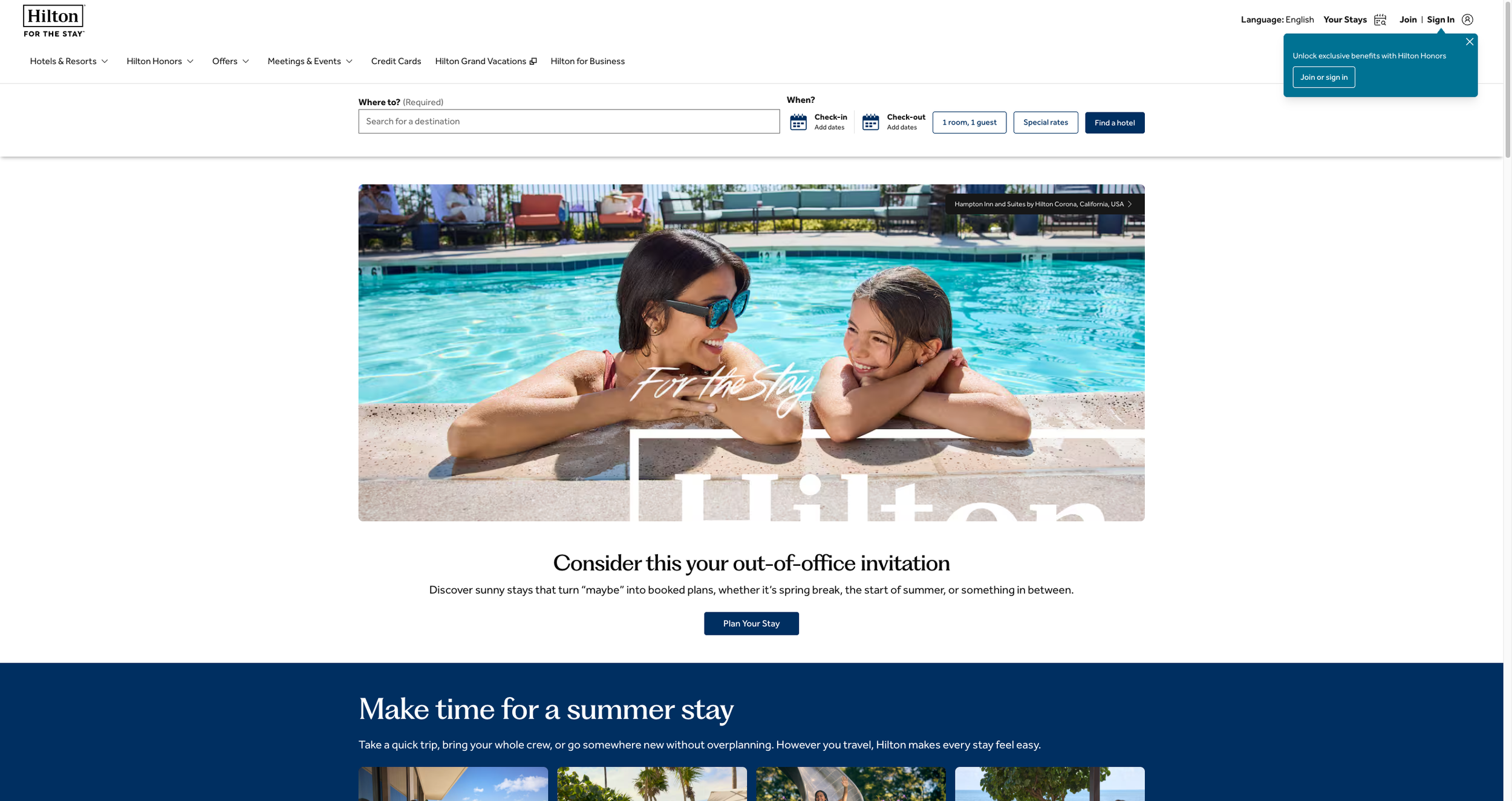
Hilton.com: Similar search bar with separate check-in/check-out fields, "For the Stay" branding, Hilton Honors join prompt in the corner.
Then we we walked through every step of the booking flow, inspected the analytics stack on every page, and documented where each company's choices reveal something about their strategy.
This isn't a "who's better" exercise. Both of these companies generate billions in direct bookings. They've made deliberate, defensible choices. The question is, what can you learn from reading those choices side by side?
The Method: Three Layers Deep
Most competitive analysis is one layer deep. Someone walks the flow, screenshots it, and says "this button should be bigger." That's fine, but it's not very useful.
We go three layers:
Layer 1: What does the experience look like? The screenshots, the flow, the decisions a user has to make. This is table stakes.
Layer 2: What are they measuring? We inspect the tag management system, the analytics platforms, the session replay tools, the advertising pixels. This tells you what the company has invested engineering resources to track. Not what they say they care about. What they actually measure.
Layer 3: What does it tell you about their strategy? This is where the interesting work happens. Connecting the analytics architecture to the UX decisions to the business trade-offs. Two companies solving the same problem, making opposite choices. Why?
Let's walk through it.
The Analytics Stack: A Window Into Digital Maturity
Before we even look at the booking flow, we inspect the page. What tools are running? What data are they collecting? This takes about 90 seconds and tells you more than an hour of browsing.
Marriott's homepage runs Adobe Experience Platform Web SDK (the modern Adobe stack) with Adobe Data Layer, GA4 via gtag.js, FullStory for session replay, Medallia for digital feedback, and OneTrust for consent management. Nine advertising platforms are firing pixels. And they're serving Google Publisher display ads on their own booking site.
Hilton's homepage runs both Adobe AppMeasurement (legacy) AND the AEP Web SDK simultaneously, plus two data layer standards (Adobe's ACDL and the W3C Digital Data Layer), GA4, and no session replay or feedback tools at all. No consent management platform visible.
Here's where it gets interesting.
When we moved to Marriott's search results and booking pages, the analytics stack changed. AppMeasurement appeared alongside Alloy. A prop value revealed their internal platform name: "Aries." The homepage is on a modern AEM frontend. The booking engine is on a legacy application. Two different technology stacks, two different analytics implementations, running in parallel during what is clearly a multi-year migration.
Hilton's stack stayed consistent across every page. Same tools on homepage, search, room selection, and checkout. Same dual implementation everywhere.
These are two different migration strategies. Marriott is migrating outside-in: modernize the brand experience first, then tackle the revenue engine when you're confident in the new stack. Hilton is running both implementations uniformly across everything, presumably planning to cut over all at once when ready.
Neither approach is wrong. But if you're a competitor (or one of their own stakeholders), understanding which strategy they chose tells you something about their risk tolerance, their engineering capacity, and where they are in the process.
What we'd tell a client: Your analytics architecture is visible to anyone who knows where to look. It reveals your modernization timeline, your migration strategy, and your platform choices. Treat it as a signal, not just plumbing.
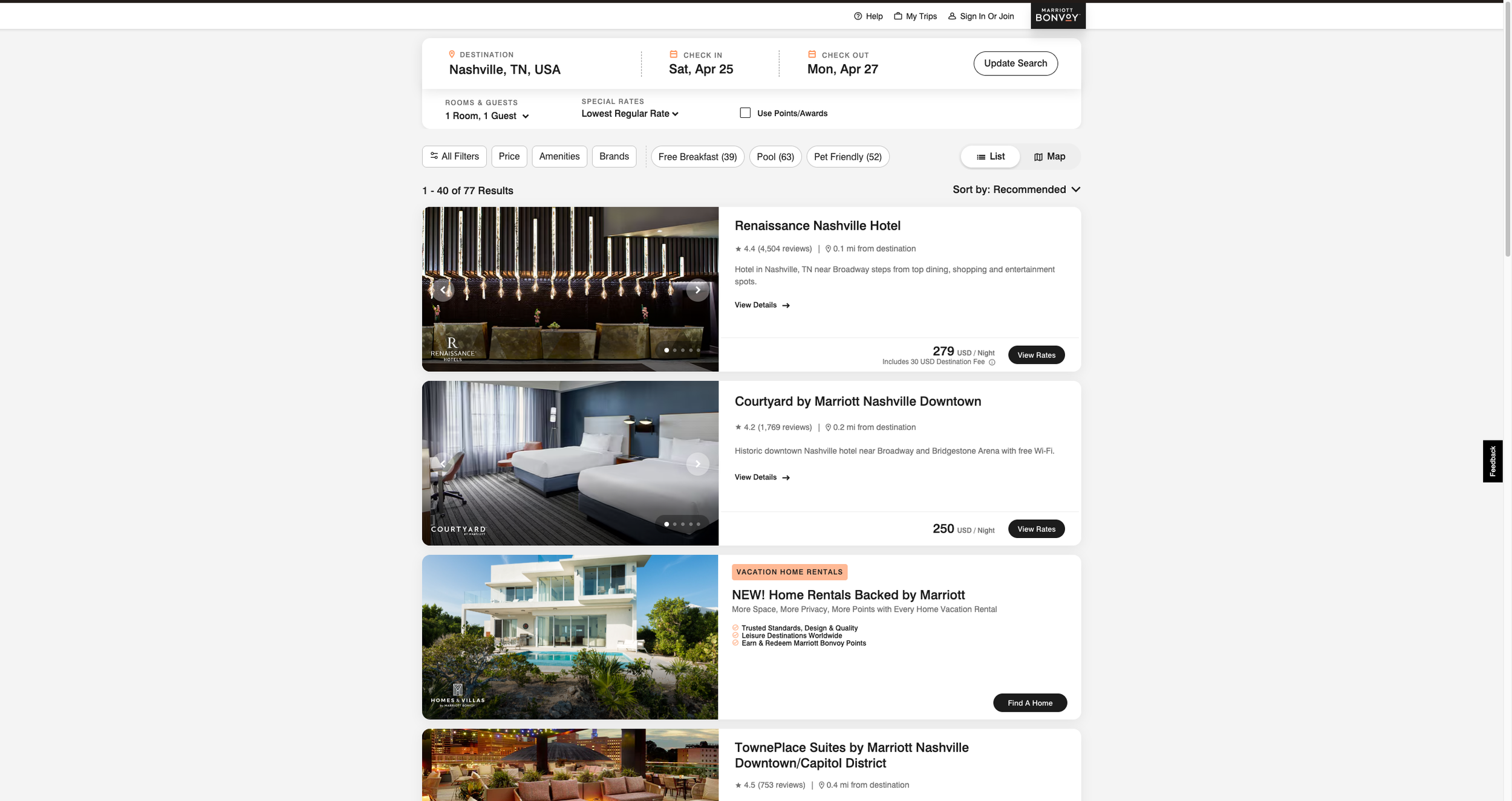
Marriott: List layout, "Sort by: Recommended," filter pills with counts, vacation home rental cross-sell injected at position 3.
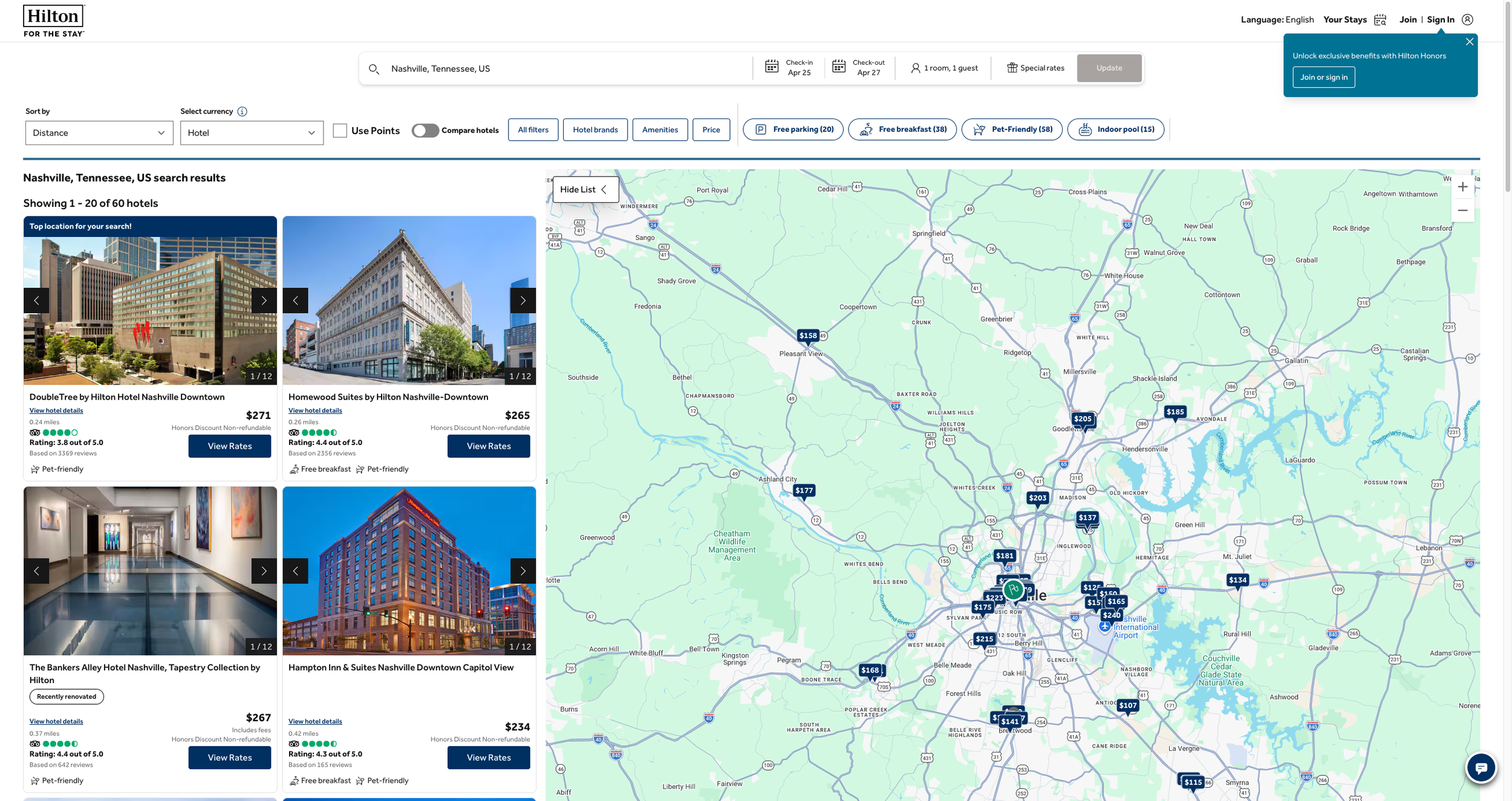
Hilton: Grid layout with integrated map, "Sort by Distance," "Compare hotels" toggle, no cross-sell injection between results.
The Booking Flow: Four Steps vs. One Page
This is the most fundamental architectural difference we found, and it shapes everything downstream.
Hilton breaks booking into four discrete steps: Select a Room, Select a Rate, Customize Your Stay, Payment. Each step has a visible progress indicator ("Step 2 of 4"). Each step has a single, clear decision. You pick a room. Then you pick a rate. Then you decide on upgrades. Then you pay.
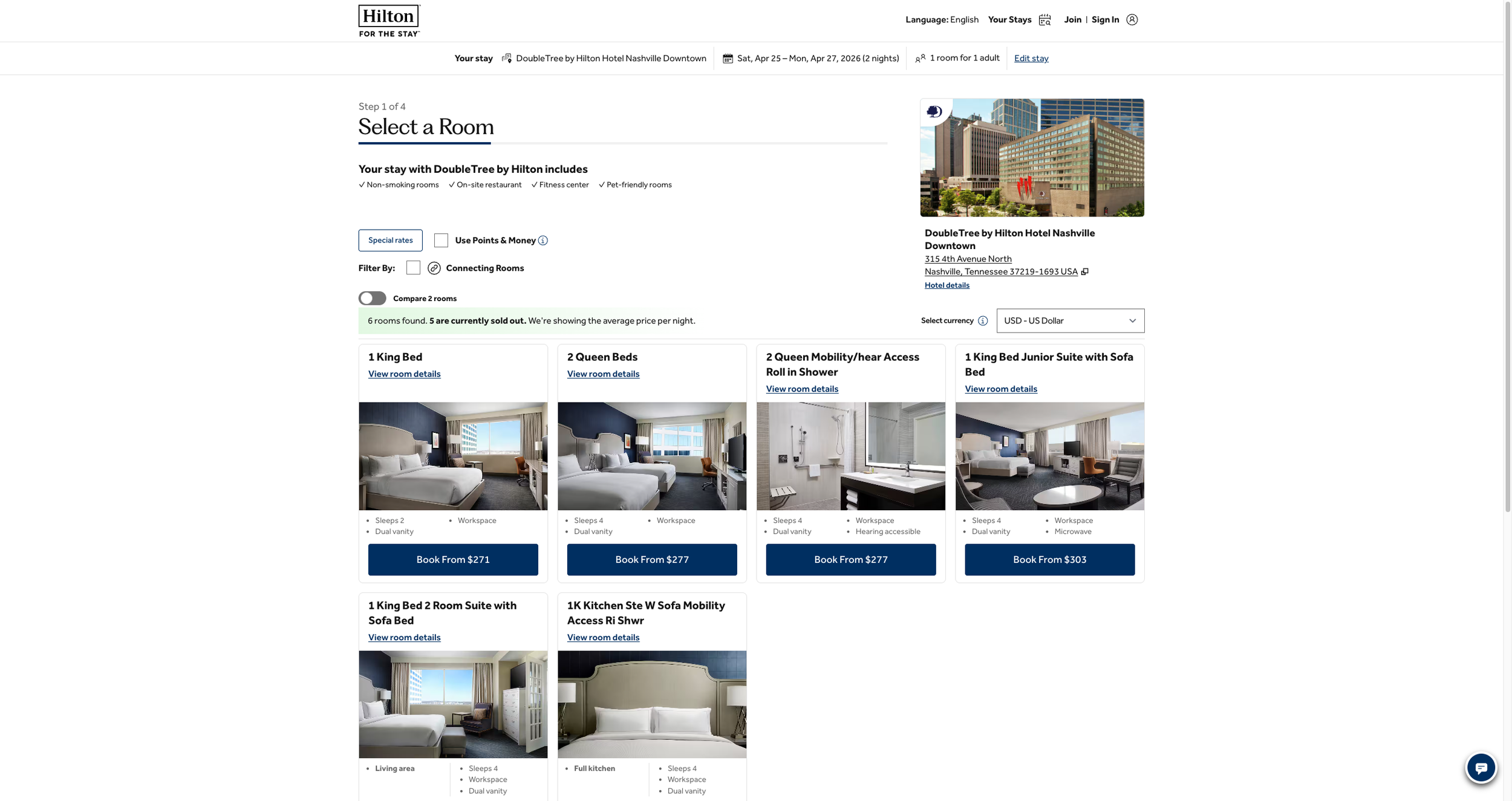
Hilton: "Step 1 of 4 - Select a Room." Six room types in a grid, one CTA per room ("Book From $271"), "5 are currently sold out" urgency signal.
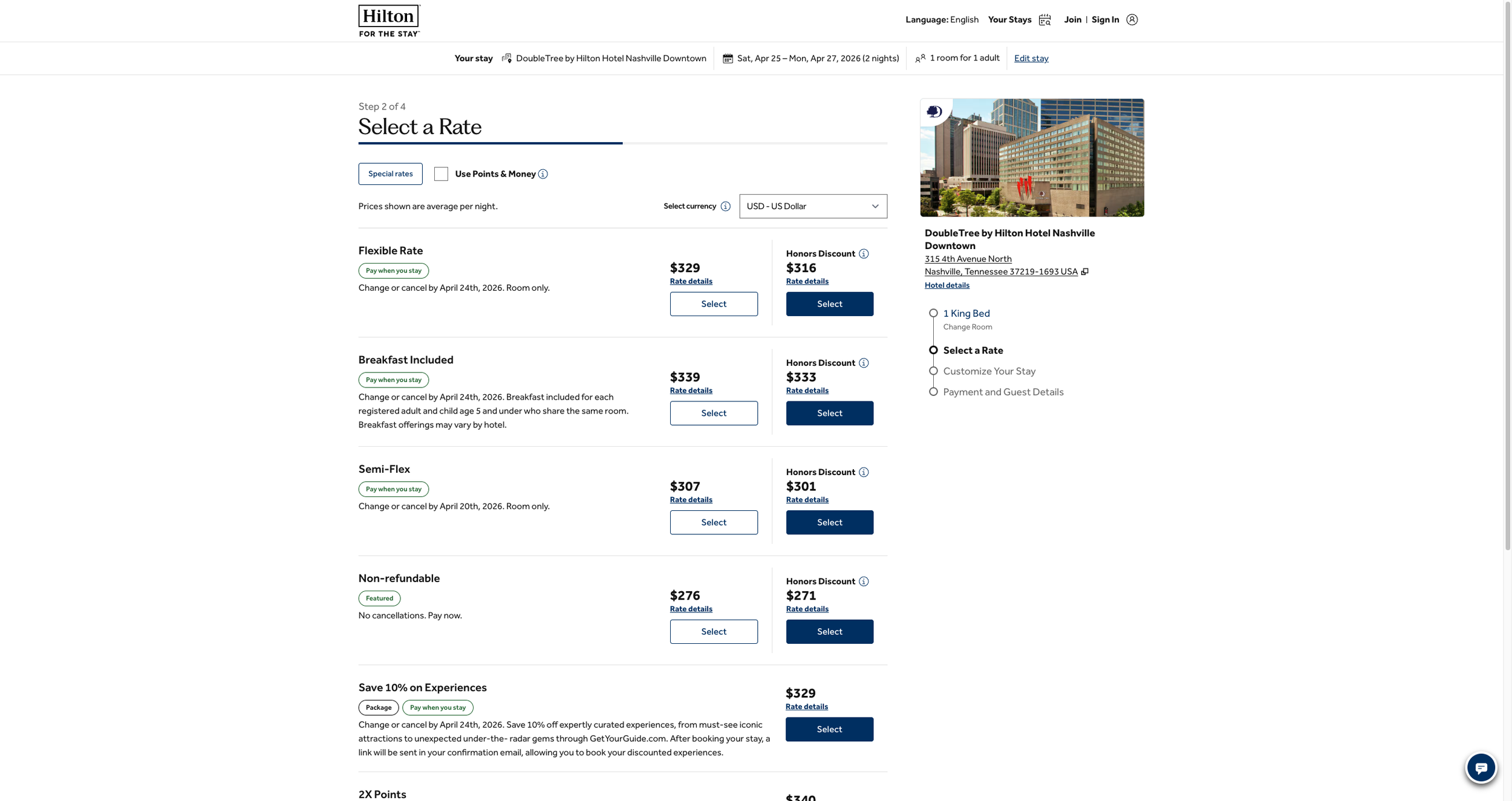
Hilton: "Step 2 of 4 - Select a Rate." Standard and Honors Discount prices side by side. Clear value quantification.
Marriott presents rooms and rates on a single page with three tabs (Standard, Prepay and Save, Deals and Packages), multiple rate options per room type, and a "Select" button for each combination. You make room and rate decisions simultaneously. Then you jump to a long checkout form with no progress indicator.
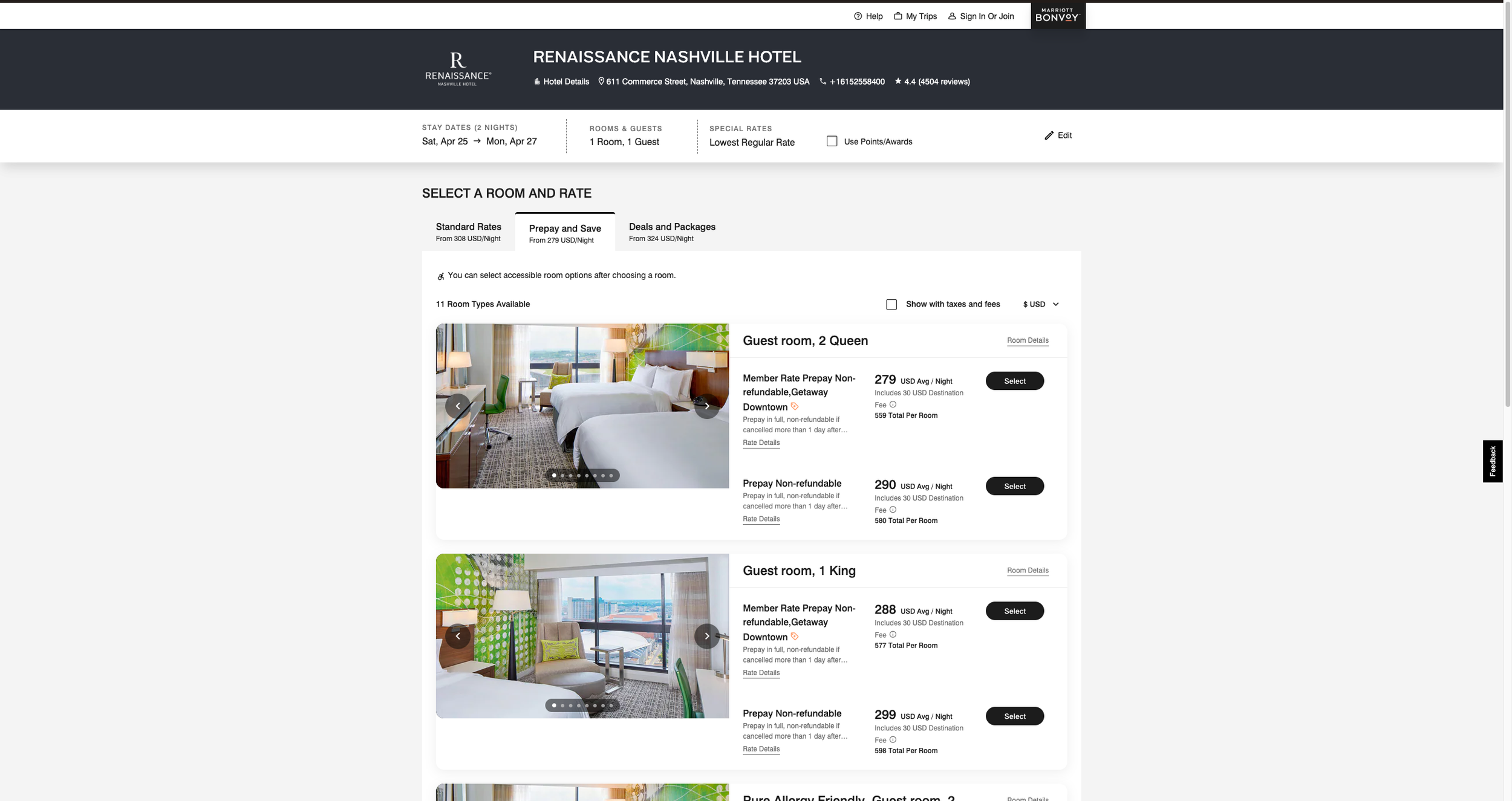
Marriott: 11 room types on a single page with Prepay/Standard/Deals tabs. Multiple rate options per room. No progress indicator.
From a consumer behavior standpoint, these represent two schools of thought about decision-making.
Hilton's approach reduces cognitive load at each step. You're never choosing between 11 room types AND 3 rate categories AND multiple price points. You're choosing a room. Then you're choosing a rate. The trade-off is more clicks.
Marriott's approach is efficient for the decisive user who knows exactly what they want. Less clicking, all information upfront. The trade-off is information density that can overwhelm, especially on mobile.
We've worked with hospitality brands on this exact question. Our experience is that progressive disclosure (Hilton's approach) tends to outperform front-loaded information for leisure travelers who are exploring options, while the single-page approach can work well for business travelers and loyalty members who book frequently and know what they want.
The test we'd run: Segment by new vs. returning booker and measure room selection rate. The answer is probably different for each audience.
Price Transparency: The $82 Question
For our test scenario, Marriott's checkout showed $657.64 plus a $30/night destination fee mentioned alongside each rate. The total with fees for two nights was roughly $718. Hilton showed $636.00, all-in. Total room charge plus total taxes, one number.
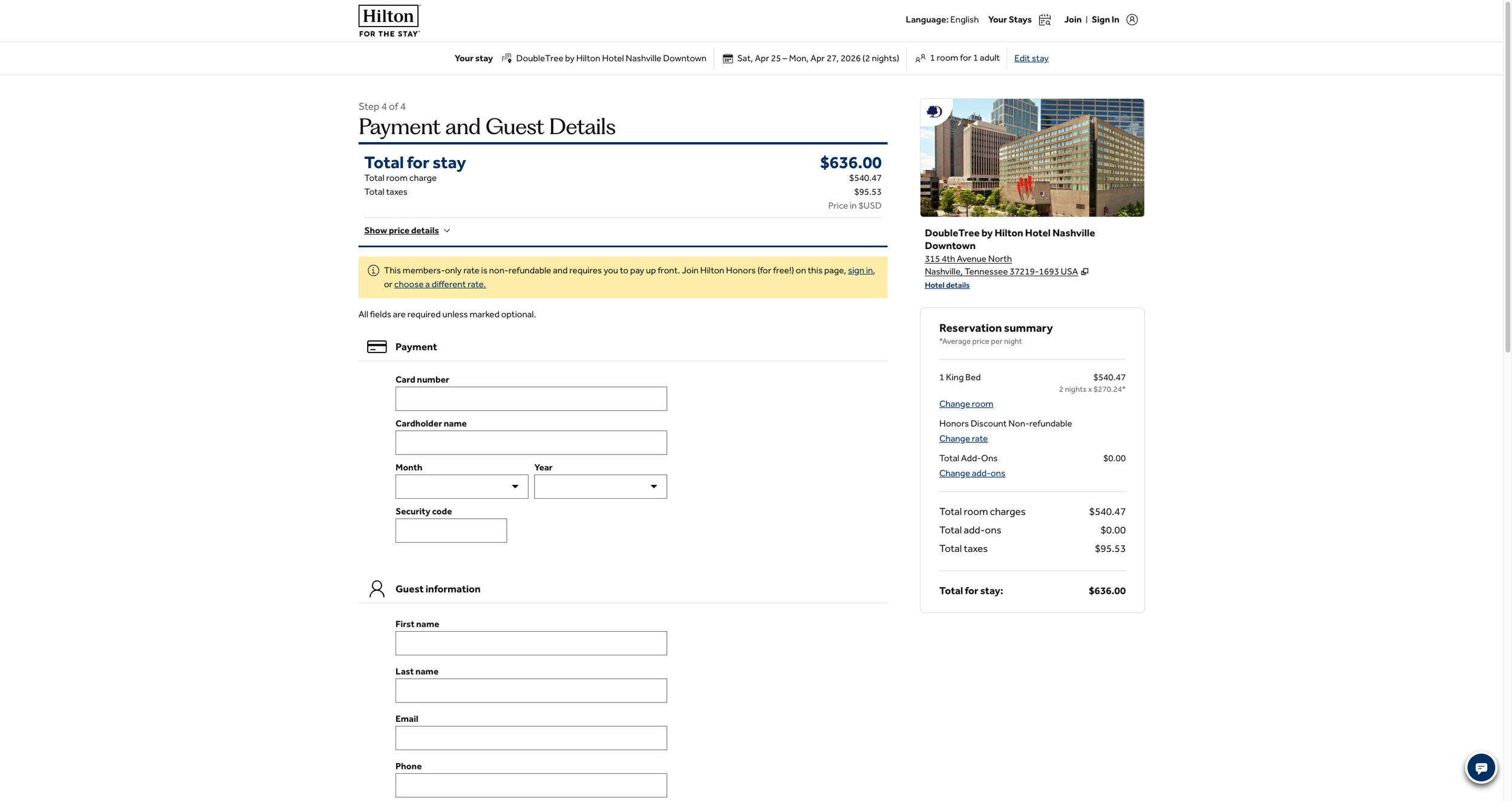
Hilton: "Total for stay: $636.00." Room charges + taxes, one number. No surprises.
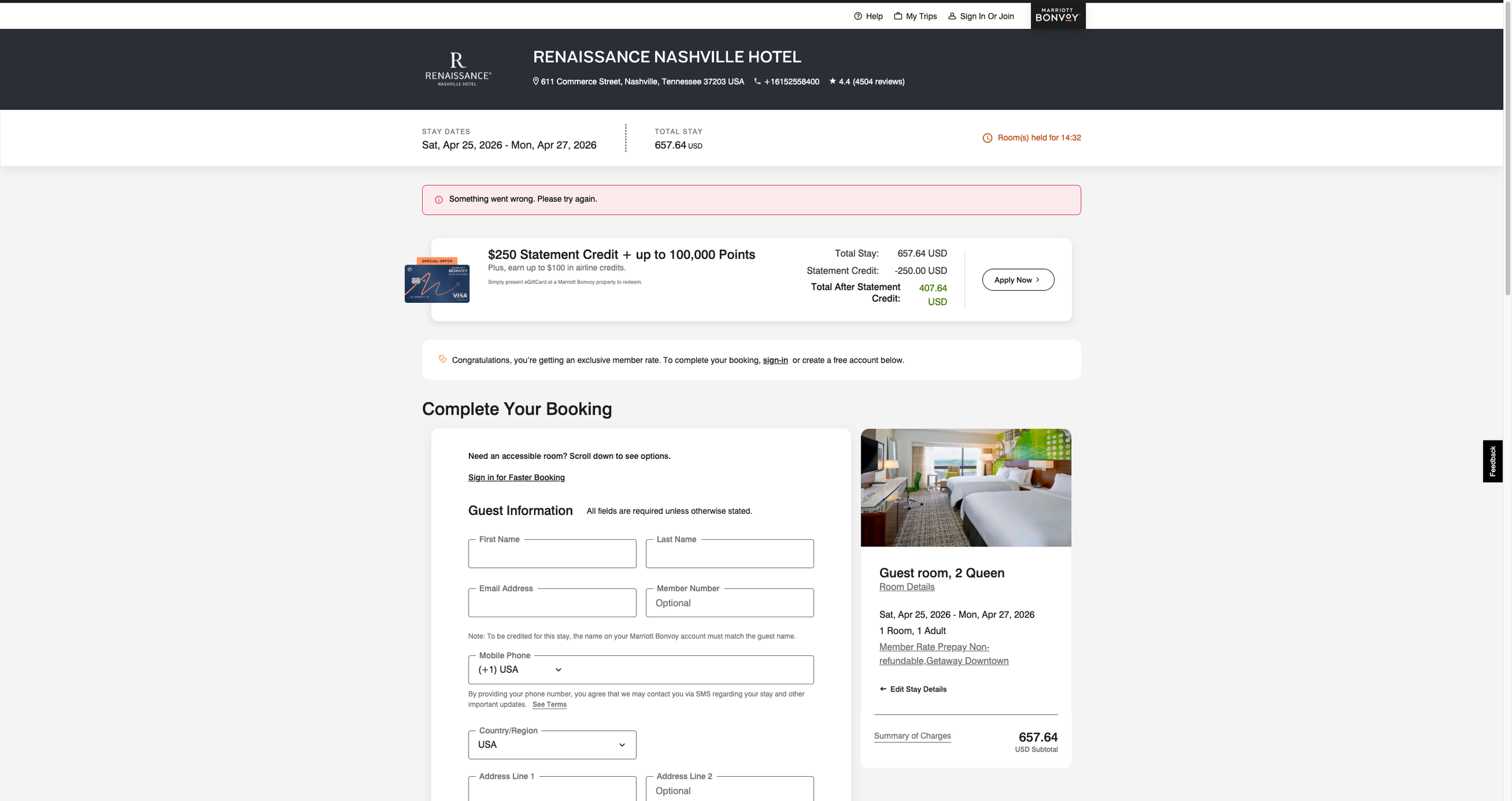
Marriott: $657.64 subtotal shown, but each rate also notes "Includes $30 USD Destination Fee" separately. Credit card cross-sell above the form.
That $82 difference isn't just about price. It's about trust at the moment of commitment.
We've tested this pattern. For a major hospitality client, we built an A/B test that combined the room rate and resort fee into a single all-in nightly rate with "Includes resort fee" messaging, versus the standard approach of showing them as separate line items. The hypothesis: transparent total pricing increases room selection rate because it removes the "what else is going to get added?" anxiety.
Marriott's approach is industry-standard. Resort fees, destination fees, facility fees. The hotel industry has long used these to advertise a lower nightly rate while collecting more at checkout. But consumer sentiment and regulatory scrutiny are both moving against this practice. The FTC's proposed junk fee rules specifically target hotel resort fees.
Hilton's clean pricing is a strategic choice that trades lower perceived nightly rates for higher trust at checkout. And based on what we've tested, for high-intent users (someone who's already selected a room and a rate), removing fee surprises at the last step tends to help, not hurt.
What we'd tell a client: Test total price transparency. The conventional wisdom that lower advertised rates drive more bookings may not hold when you measure full-funnel conversion, not just search results click-through.
The Checkout: 19 Fields, No Apple Pay, and a Credit Card Offer
Marriott's checkout is a single page with 19 form fields: name, email, phone, full mailing address, credit card details, and forced loyalty enrollment (password + confirm password). No digital wallet options. No Apple Pay, no Google Pay, no PayPal. Above the form, before you even enter your name, there's a Chase credit card cross-sell: "$250 Statement Credit + up to 100,000 Points. Apply Now."
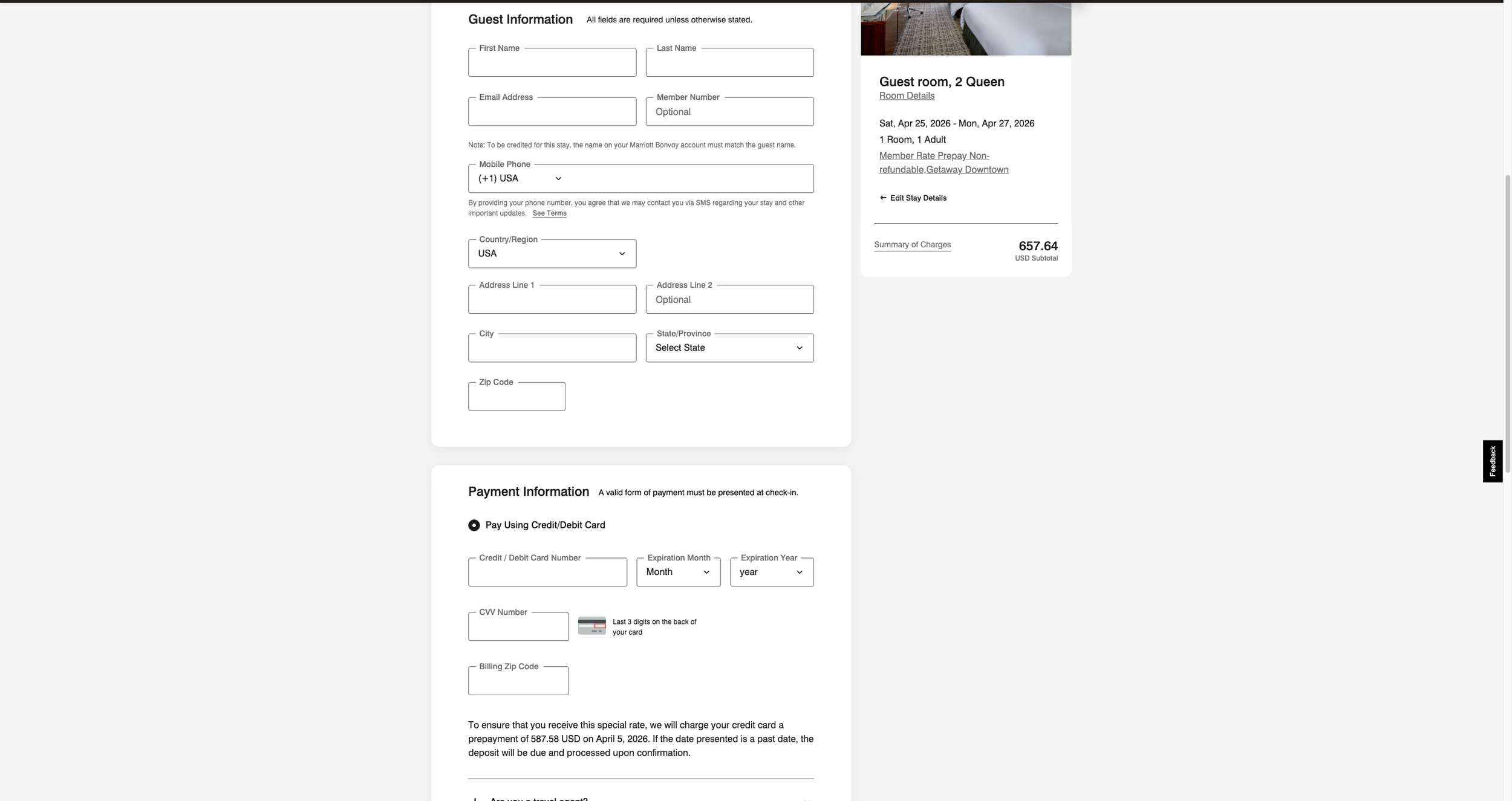
Marriott: Guest information, full address, credit card fields, all on one page with no progress indicator. "Pay Using Credit/Debit Card" is the only payment option.
Hilton's checkout has 17 fields on the payment page (Step 4 of 4), similar categories. Also no digital wallets. But no credit card cross-sell anywhere in the flow, and the loyalty enrollment is positioned more gently: "Join Hilton Honors to get the Member discount + Digital Check-In. It's free and easy. All we need from you is a password."
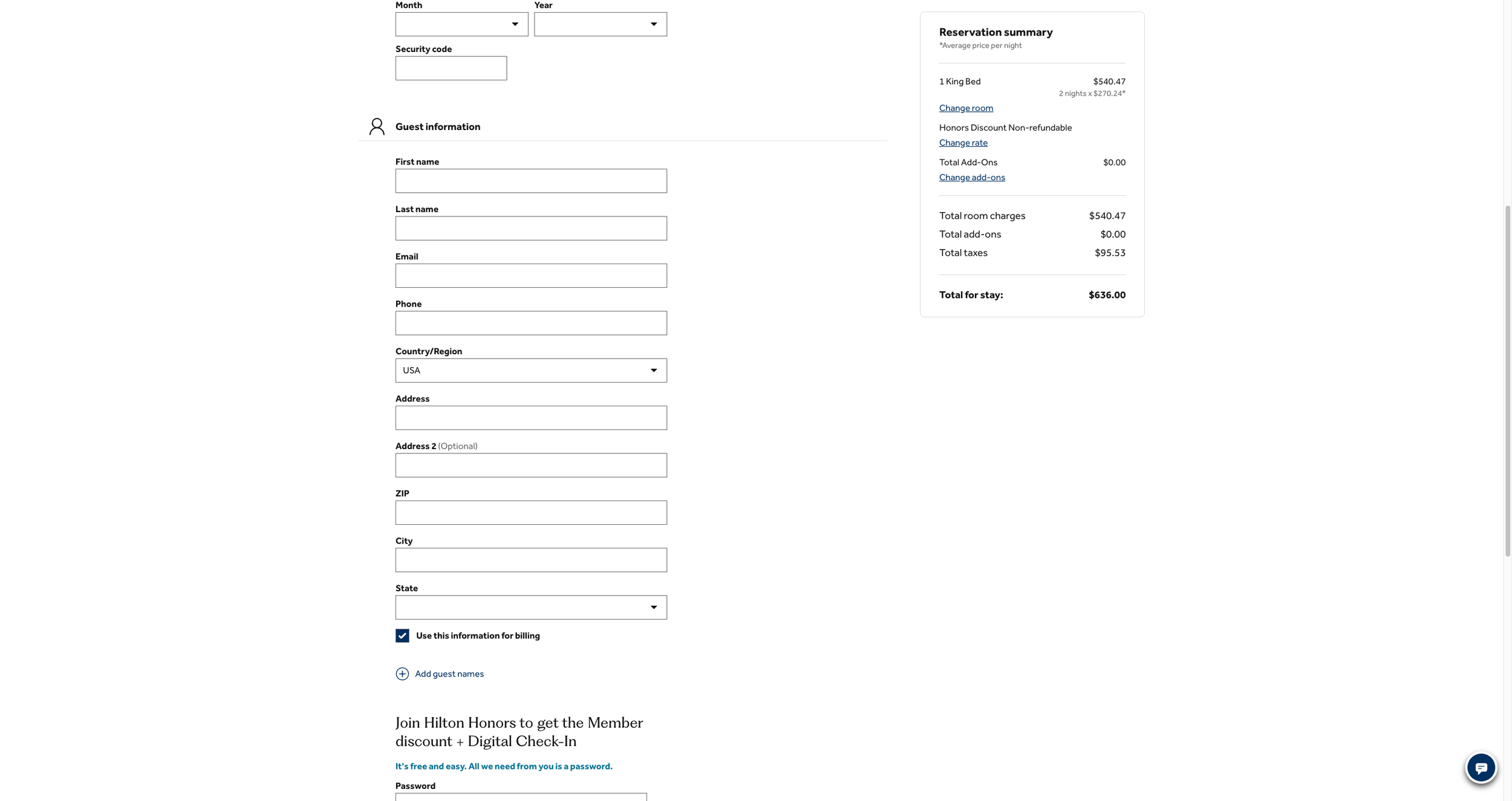
Hilton: Similar field count, but labeled "Step 4 of 4." Reservation summary with full price breakdown stays visible in the sidebar.
Let's talk about each of these.
The field count. 17-19 fields on desktop is manageable. On mobile, it's a form marathon. We've analyzed booking flows where the mobile-to-desktop conversion gap was 5x, and when we actually walked the mobile flow, we found a 15-field form with no progress indicator and hidden remaining steps. The field count was the same on both devices. The perception of friction was completely different.
Hilton's progress indicator ("Step 4 of 4") tells you exactly where you are. Marriott's single-page checkout makes you scroll and wonder how much more there is. Same data collection. Different experience.
No digital wallets. This is the single biggest shared opportunity. Apple Pay reduces a mobile checkout to two taps. For a $636-700 transaction, eliminating 15+ form fields of manual entry is transformative. We've seen what payment simplification does to mobile conversion in hospitality. The gap between "interested enough to select a room" and "willing to thumb-type a 16-digit card number on a phone" is where bookings die.
Neither Marriott nor Hilton offers this. For two companies that collectively operate over 14,000 properties worldwide, this represents a meaningful conversion opportunity sitting on the table.
The credit card cross-sell. Marriott places a Chase Boundless card offer above the checkout form, complete with a competing "Apply Now" call to action. From a partnership revenue perspective, this makes sense: every checkout page view is an impression opportunity. From a conversion perspective, you've introduced a second decision ("should i apply for this card first?") at the moment of highest abandonment risk.
Our approach with clients: upsells and cross-sells belong in moments of low cognitive load, not high. Hilton's "Customize Your Stay" step (Step 3) is a dedicated upsell moment. The user has already committed to a room and rate, reducing anxiety. Offering a room upgrade for +$33/night in that context is low-friction. Offering a credit card application before the user has even entered their name is high-friction.
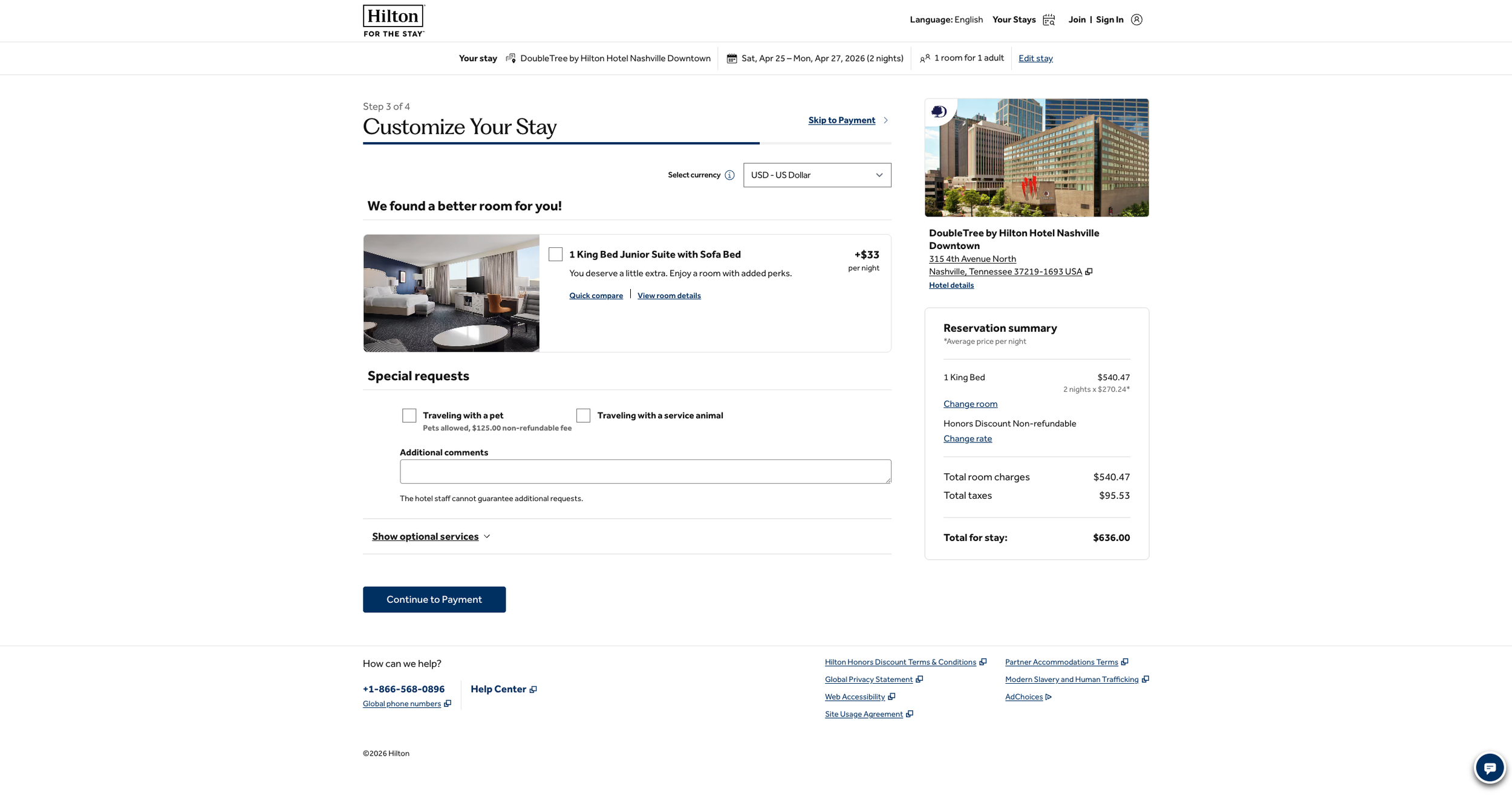
Hilton: A dedicated upsell step. Room upgrade offer (+$33/night), special requests, optional services, and a "Skip to Payment" link for users who don't want to customize. Reservation summary with full price breakdown in the sidebar.
What we'd tell a client: Audit your checkout for competing CTAs. Every element on a checkout page that isn't driving toward completion is a potential exit. Move partnership offers to the confirmation page (post-conversion) and measure the impact on both booking completion and credit card application rates. You might find you get more of both.
Loyalty Positioning: Two Approaches to the Same Goal
Both companies want non-members to become members during booking. Both require account creation to get the member rate. They take very different paths.
Marriott shows member pricing on the room selection page as the primary rate ("Member Rate Prepay Non-refundable, Getaway Downtown" at $279/night). When you select it, checkout reveals the catch: you need to create a Bonvoy account. The loyalty enrollment section has pre-checked boxes for "Join Marriott Bonvoy now for free" and "I would like to receive personalized communications, including offers, details about promotions, and travel-related products from the Marriott Group via email."
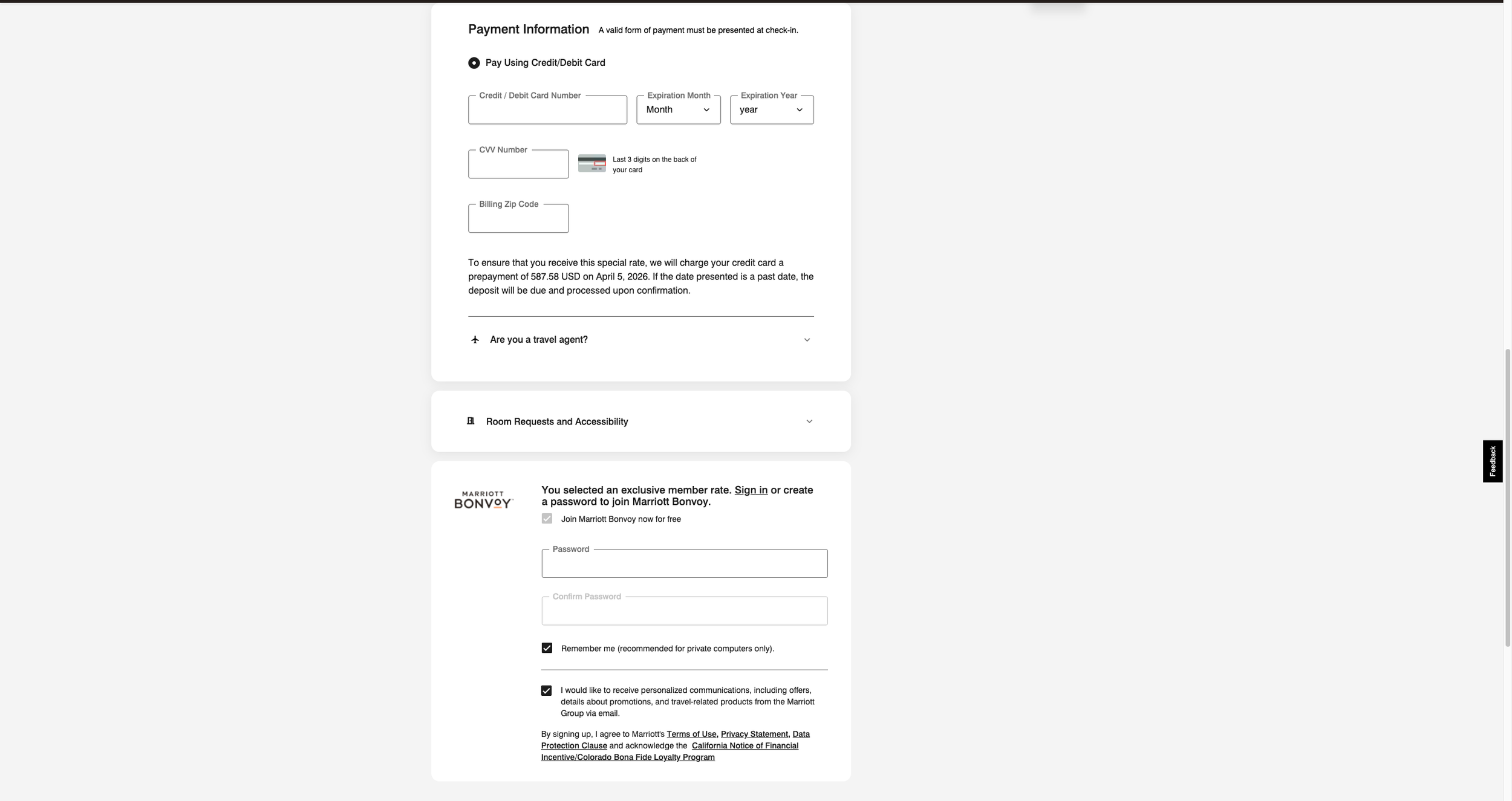
Marriott: "You selected an exclusive member rate." Pre-checked marketing consent, password + confirm password fields.
Hilton shows standard and Honors Discount pricing side by side in a clean two-column layout on the rate selection page. $329 standard vs. $316 Honors Discount. The value of membership is immediately quantifiable: $13/night. At checkout, loyalty enrollment is framed as: "It's free and easy. All we need from you is a password." Marketing consent is NOT pre-checked.
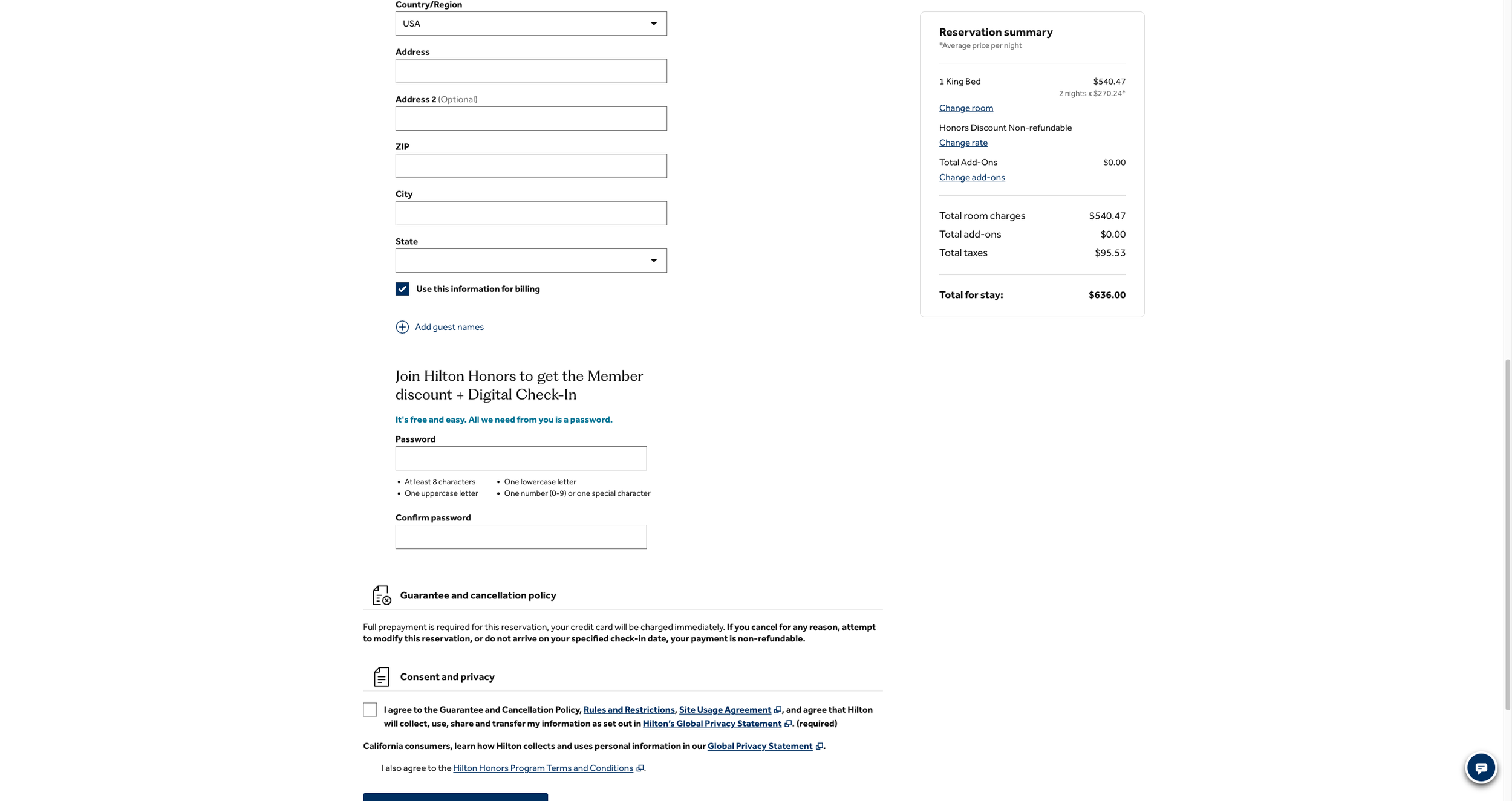
Hilton: "Join Hilton Honors to get the Member discount + Digital Check-In." Consent checkbox is NOT pre-checked.
Both approaches acquire members. The question is which approach builds more trust.
Pre-checked marketing consent is effective in the short term (higher opt-in rates) but increasingly scrutinized by regulators and consumers. Hilton's opt-in approach may capture fewer email subscribers per booking, but those subscribers chose to receive marketing, which typically means higher engagement rates and lower unsubscribe rates downstream.
We've done extensive personalization work for hospitality brands, including holdout analysis across audience segments. The pattern we see: value clarity (Hilton's "$316 vs. $329, you save $13") outperforms value obscurity (Marriott's dense rate naming) for new member acquisition. People join loyalty programs when the benefit is obvious and immediate, not when the program name is embedded in a rate label.
What You Don't See: Testing Architecture
Neither Marriott nor Hilton surfaces client-side A/B testing libraries (Optimizely, VWO, etc.) on any page we inspected. This likely means they're running experiments server-side or through their personalization platforms (Adobe Target via the Web SDK, for example). That's actually a more mature pattern. It eliminates the flash of original content, keeps test logic off the client, and means competitors can't easily reverse-engineer your testing program by inspecting the page.
We build testing programs for hospitality brands, and the sophistication required is significant. Booking flows are complex: single-page applications with React re-renders that wipe injected DOM changes, lazy-loaded content that appears on scroll, conditional pages that only show for certain booking types, and legal guardrails that mean you can never show a rate that isn't currently bookable.
The point isn't whether Marriott and Hilton are testing. They almost certainly are. The point is that what you can see on the page is only one layer of the competitive picture. The tools you don't see tell you just as much about the company's approach.
The Observation We Didn't Expect
Marriott runs Google Publisher display ads on their booking site. A banner ad in an iframe on the homepage. We didn't see this on Hilton.
This is a deliberate revenue decision. Marriott is monetizing their booking traffic with display advertising, which means they've decided the incremental ad revenue exceeds the conversion cost of the distraction. Or they haven't tested it.
Either way, it's a signal. When a company with Marriott's resources chooses to serve third-party ads alongside their own booking flow, it tells you something about how they think about the commercial value of each page view. Hilton's absence of ads tells you they've made the opposite calculation (or never considered it).
What we'd tell a client: If you're running ads on your own booking pages, test removing them and measure the impact on booking conversion. The CPM you're earning might be costing you multiples in lost bookings.
What Competitive Analysis Actually Is
This exercise took us about two hours. We walked two booking flows, inspected the technology stack at every step, and produced a comparison that reveals strategic differences you can't get from a press release, an earnings call, or a competitive intelligence platform.
The insights aren't about which site is "better." They're about understanding what each company has prioritized, what trade-offs they've accepted, and what that means for the competitive landscape your brand operates in.
When we do this for clients, the output isn't a report that sits on a shelf. It becomes hypotheses: test total price transparency. Test a multi-step booking flow for leisure segments. Test removing competing CTAs from checkout. Add digital wallets. These are grounded in observed patterns, not abstract best practices, because we've seen what happens when you actually run these tests.
That's the difference between looking at a competitor's website and understanding their strategy. One takes five minutes. The other takes a decade of doing the work.
jason thompson is the founder and CEO of 33 Sticks, a data strategy and analytics consultancy. He's spent 20+ years helping brands turn digital experiences into measurable outcomes.